Tuesday, October 02, 2012

Gilding and Patinating

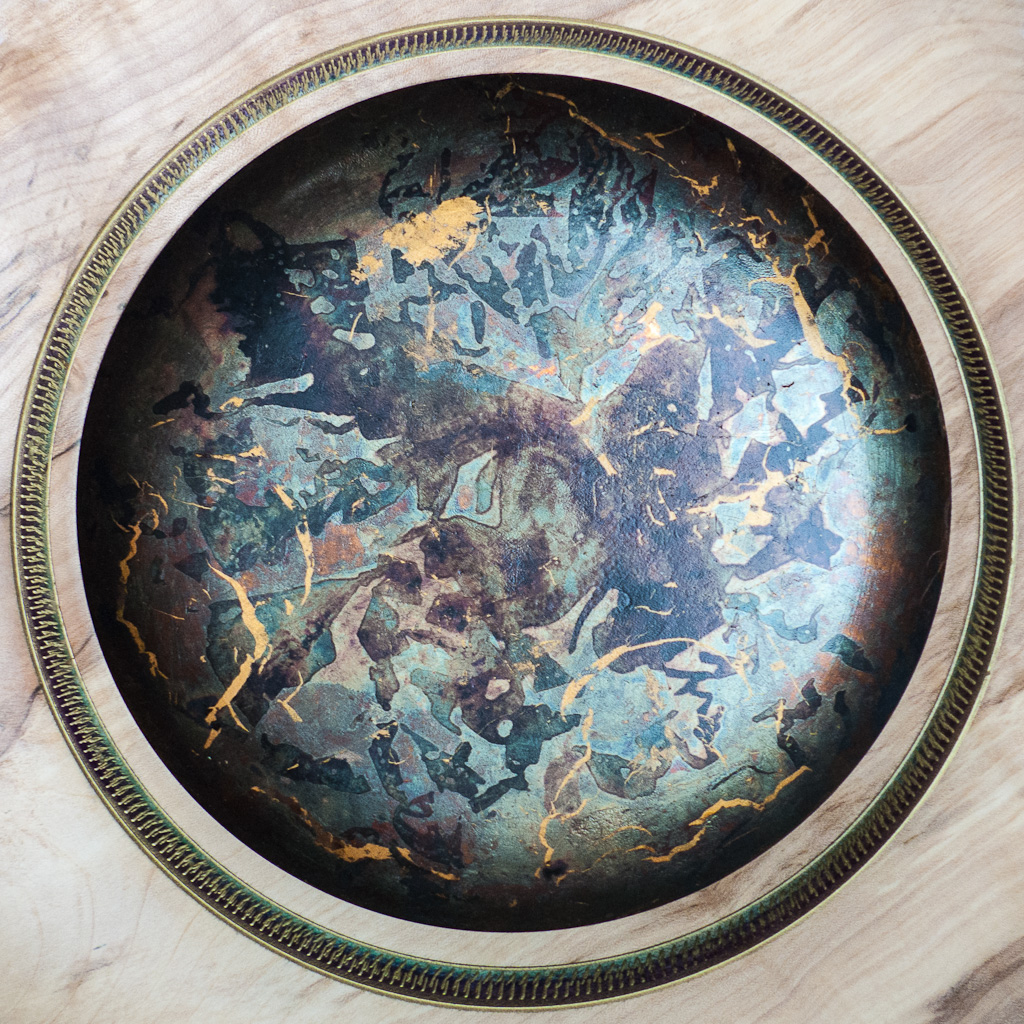
I've been working on gilding with silver leaf and patinating with liver of sulfer (sulfurated potash). The colour of the glaze under the leaf as well as the duration of the 'soak' has a noticeable effect on the look of the gilding .

The first piece was underglazed with Indian red gouache and fumed for an hour.


Sycamore hollow form 8" x 5"
Silver leaf, ebony, and faux bone
Top view


The platter was under glazed with gold enamel then gilded with copper and silver on top. Again it was fumed for an hour.
Sycamore platter 14" x 2 1/2"
Silver on top of copper leaf, textured band with gilding cream
Top view

The urn was under glazed with red and blue acrylic and fumed for about 45 minutes. A leaf pattern was textured around the top with a pyro tool.

Beech urn 12" x 5"
zebrano and ebony cap

Sunday, April 15, 2012

Earring (Saturn) box and more

An earring box for Ali. Putting together a piece from multiple parts is time consuming but it's an enjoyable challenge to try and get the proportions right. The cherry was from a log in the woods behind our house which had been felled a number of years ago and there was only a little of solid timber to get out of it. Thanks to Gary Wall for his gift of some ebony blanks.

The second and third pieces each have a band of antiqued foil which is a new technique I'm working on.

The last two pieces have rims painted with iridescent paints.


Earring box in cherry and ebony
3 1/2" x 9"
Cherry bowl 7" x 4"

Sycamore platter 10" x 2"


Beech bowl 8" x 3"


Sycamore platter 15" x 2"


Thursday, February 23, 2012

Silver leaf and more


My second attempt at patinizing silver leaf was successful. After applying the leaf I laid crumpled tissue paper in the bowl and sprayed the paper with a solution of 1 part liver of sulphur concentrate to 70 parts espresso coffee at 120 degrees F. I placed a plate on top to stop evaporation and left it for 45 minutes before rinsing it with warm water from a spray bottle to stop the colouring. (I think my first effort last summer failed because I used a different manufacturers silver leaf which was probably imitation).

Looking forward to using the effect on hollow forms and platters.

The next two pieces I used my £2.50 'airbrush' for decoration and finally a salad bowl in sycamore.


Bowl in sycamore 8" x 4 1/2"
acrylic paint, silver leaf, varnish

Platter in sycamore 15" x 2"
acrylic paint, shellac, and wax


Bowl in apple 6" x 4"
acrylic paint and varnish

Salad bowl in sycamore 15" x 4"
walnut oil

Friday, February 03, 2012

Pewter and laburnum


All the pewter at my home is now in danger of meeting the melting pot. At about £35 per kilo I'll probably wait until boot sales start up this spring to replenish supplies. (Anyone have any lying around that is of no use?)

I found it handy to prepare the pewter elements in advance to fitting on the green timber. The ring on the end grain bowl was fit with a tongue and groove joint and epoxy. The foot ring inserts are a handy way to decorate and clean up the foot.

Bowls are finished with oil and wax.

Laburnum and pewter end grain bowl
5 1/2" x 4 1/2"

Laburnum cross grain bowl
8 1/2 " x 3 1/2"

Foot ring and insert detail
Wikipedia entry on laburnum
All parts of the plant are poisonous, and can be lethal if consumed in excess. Symptoms of laburnum poisoning may include intense sleepiness, vomiting, convulsive movements, coma, slight frothing at the mouth and unequally dilated pupils. In some cases, diarrhea is very severe, and at times the convulsions are markedlytetanic. The main toxin in the plant is cytisine, a nicotinic receptor agonist. It is used as a food plant by the larvaeof some Lepidoptera species, including the buff-tip.

Wednesday, January 25, 2012

More fun with colour

The first bowl in cherry has the exterior finished with Plastikote two-part crackle, Jo Sonja gold iridescent acrylic, and Wood Doc 20. I thinned the gold paint hoping to apply it with an atomiser tube but couldn't blow hard enough to raise the paint. Ha, stuck a dusting needle from the compressor into the blow pipe, turned it up to 80 psi and out came the paint! The softer wood within each growth ring took more paint and added a pleasant grain effect.

The next two bowls are coloured with the Sonja iridescent paints applied by sponge.

The final piece is a small cross grain elm platter with the rim decorated with the Plastikote crackle. (I'm getting better results with the crackle on face grain.)


Cherry end-grain bowl 7" x 5"


Sycamore bowl 7" x 3 1/2"


Sycamore bowl 8" x 5"


Elm platter 7" diameter

Wednesday, January 11, 2012

Exploring Colour and Texture

I've been cutting a lot of open bowls lately just to have some pieces to play with. Each additional material or technique seems to add exponential possibilities. I'm definitely straying from the adage that less is more.

The first two bowls have Jo Sonja iridescent acrylic applied over a darker undercoat. I've brushed the thinned acrylic at slow and high revs and finished with a few coats of lacquer. It will take a lot of play and experimenting to find a technique that is really pleasing.

The third bowl is cross grain sycamore bowl died with spirit stain and  textured with a Crown tool with a gold gilding cream rub and finished with Chestnut wax.

I think that the direction I'm taking is a result of near constant woodturning for a few years. What matters to me is to stay excited.


End grain cherry
6" x 3"

Cross grain sycamore
8" x 3"

Cross grain sycamore
10 1/2" x 3 1/2"

Toni's sugar pot
Laburnum and holly lid

Friday, December 16, 2011

Simon Hope

Simon

Spent last weekend with Simon Hope. What an enjoyable two days of woodturning. My main interest was working with pewter but I picked up lots of tips and inspiration.

A bit cold sleeping in the van on Saturday night but an impromptu blow on the bagpipes and a cup of tea from Simon Sunday morning warmed me right up.

We turned a few finished pieces and one knotty lampshade in walnut. Pics follow.

I can't recommend Simon highly enough.

I'll be back.

I thought my shop was inclined to be messy!


Walnut box

Yew bowl

Purpleheart box


Tuesday, November 29, 2011

A bit of fun with scraps and offcuts provided me with some xmas gifts for family. Various woods were used including beech, sycamore, holly, cherry, laburnum, and a couple of exotics.


Friday, October 14, 2011

Salsa Verde

A decent if slightly dissapointing crop of tomatillos this summer has given me enough fruit for several batches of salsa verde to freeze for winter craving.


Please leave a comment with your email address and I'll happily share the recipe!

Wednesday, September 28, 2011

Colouring and Texturing

Having returned from a woodturning cruise in Norway at the end of August, I've been busy putting some new ideas to task. Results from the tooling is a bit unpredictable but that's part of the fun. Thanks to Nick Agar for the inspiration.


Textured Yew Bowl

Cherry Boxes

Textured Sycamore Bowl


Tuesday, July 12, 2011

Tartine Bread

Not exactly turning but an enjoyable craft that you can eat. The method is simple and the results fantastic.I can't recommend the book highly enough. Many thanks to Mark Gascoine for renewing my interest in bread (and thanks for the starter).

Toni

Preparing to mix the dough


Folding the dough

Absolutely delicious

Recent Turning

Hollowing is a chore so a little spindle work to make a finial makes for a pleasant change.

Urn spalted beech and laburnum
8" by 15"

This green cherry crotch distorted attractively around the rim. Quick turning helps.

Cherry platter
8" by 3 1/2"
I've promised to bring a few pieces on the Norwegian woodturning cruise so I'm trying to come up with some interesting smaller shapes.


Lidded box spalted beech and ebony
4" by 4"
A friend kindly gave a big section of reclaimed beam from Coventry Cathedral. Phil Irons told me the likely species as a lot of timber was brought back to the UK from Australia as ballast in the late 18th century. (Forgot the name.)

Bowl reclaimed timber from Coventry Cathedral
8 1/2" by 5"

Wednesday, June 01, 2011

Two Approaches

Seasoned or green?

Finial bowl in maple and beech 9" x 3"
The seasoned block of maple required a lot of elbow grease to turn, created lots of dust, and felt like a lot of work. It finished nicely with a little Chestnut wax after sealing.


Spalted holly 9 1/2" x 4"
The cross-grain holly was rough cut to an inch thick and wrapped in plastic overnight. The following day it was turned to size, microwaved twice on high for 90 seconds (an hour apart) and saturated with mineral oil. Sealed in plastic again overnight for a rest and then exposed to let it relax and distort. A few cracks appeared but it held together remarkably well. I quite like turning green timbers that distort if I can manage to keep them from exploding.

For my turning green timber is a lot more enjoyable although unpredictable (plenty of failures) and generally takes several days to complete. In the end the pieces are unique, have character, and I enjoy picking them up.